What Multi-Agent Supervision Looks Like When Your Fleet Is Doing Real Work
Multi-agent supervision is real-time visibility, a trustworthy audit trail, and provenance-bound recovery. Here's what it looks like when a fleet does real work.

One agent is easy to keep an eye on. You give it a task, you read what it produced, you decide whether it did the job. Supervision is just paying attention.
A fleet is a different problem. Five agents, then ten, then twenty, running in parallel, handing work to each other, some waiting on an approval, one of them quietly retrying a task that failed twenty minutes ago while you were looking somewhere else. Paying attention stops scaling. The question is no longer "is this output any good?" It is "what is my whole fleet doing right now, and who is accountable for it?" Multi-agent supervision is the name for answering that question well, and it is not a single dashboard feature. It is three things working together: real-time visibility, an audit trail you can trust, and recovery that stays accountable when something breaks.
The supervision gap
There is a gap between "I can see that my agents ran" and "I know what they did and who owns the result." Most operators live in that gap without a name for it. You have logs, you have outputs, and you still cannot answer the plain questions a founder should be able to answer in a second: which agents are working right now, what are they working on, and where did this piece of work come from.
The gap opens the moment work goes parallel. With one agent there is one thread to follow. With a fleet there are many, and they cross. Agent A finishes research and hands it to Agent B to draft. Agent B hands the draft to Agent C to review. Somewhere in that chain a task gets reassigned, a context gets dropped, or two agents start working the same issue without knowing it. This is where operators reach for language they don't quite have yet. They say they want to see all agents at once: not one log at a time, all of them, on one surface. And they say they need agent handoff visibility, proof that when work moved from one agent to the next, it actually moved, cleanly, and nothing fell on the floor.
Those two phrases describe the same underlying need. Supervision at fleet scale means a surface where the whole fleet is legible at a glance, and where the handoffs between agents are as visible as the work inside each one.
What a work timeline gives you
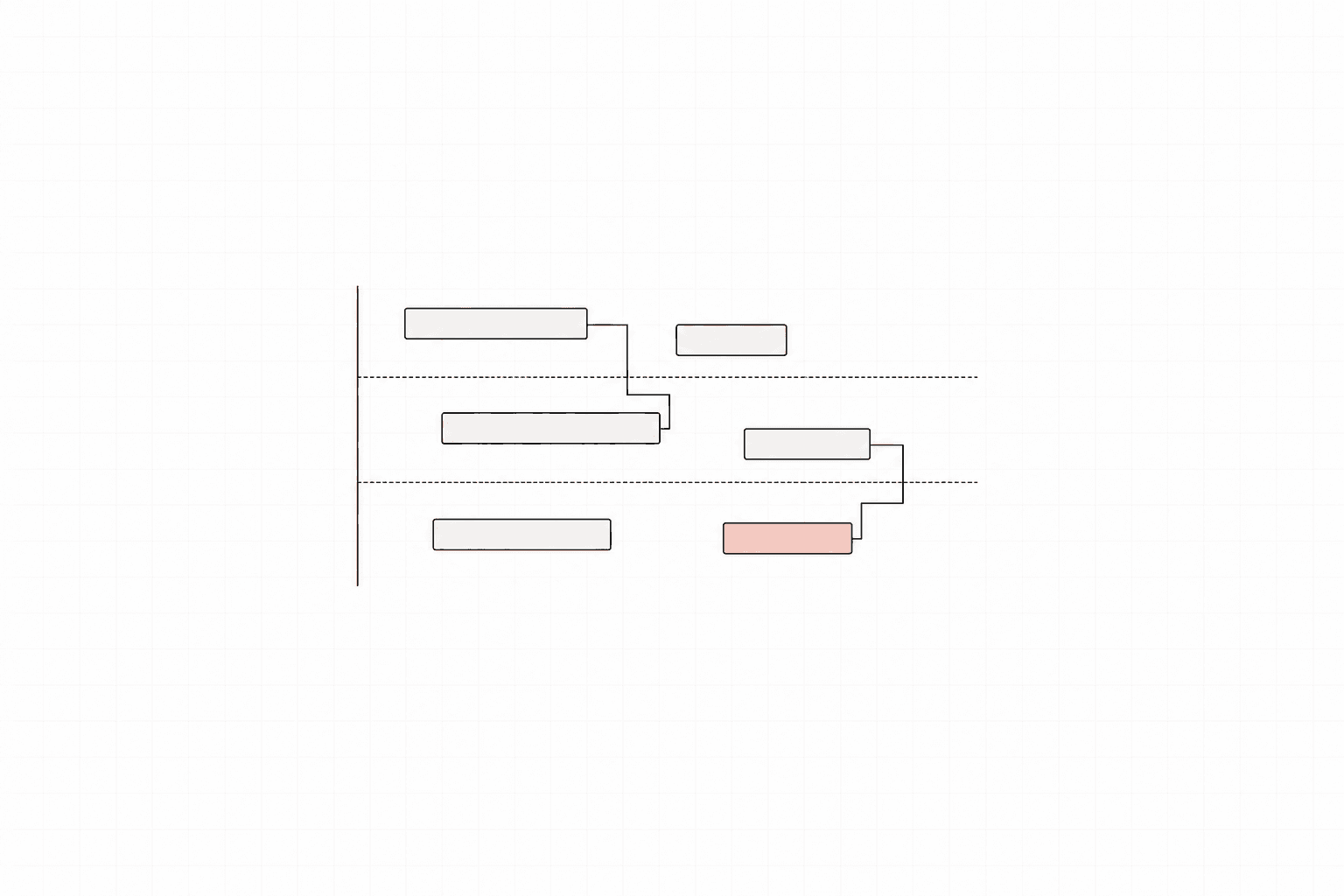
The most direct answer to "see all agents at once" is a timeline. This is the Paperclip Work Timeline, and it is worth walking through what it actually shows, because the shape of it is the point.
Picture a lane for every actor in your company: each agent, the system, and any human in the loop. Along each lane runs a series of bars, and each bar is a run: one agent, working one task, with a start and an end. The bar carries the task it belongs to and its state, so you can tell at a glance what is running right now, what succeeded, what failed, and what was cancelled. Stack those lanes together and you have the Gantt view of your fleet: not a wall of log lines, but a picture of who worked, on what, and when.
The part that matters most for supervision is what sits between the lanes. When one agent hands work to another, that handoff is drawn as a link from one lane to the next: an assignment, or a delegation from a manager agent down to the agent it tasked. That is agent handoff visibility made concrete. You are not inferring that work moved from a gap in the logs. You can see the edge, from actor to actor, at the moment it happened, tied to the task it carried.
Read together, the lanes and the links answer the questions the supervision gap left open. Which agents are active? The lanes with a live bar. What is in flight versus done, and where did a task travel before it landed here? The state on each bar answers the first; the handoff links, traced back through the fleet, answer the second. A work timeline turns "my agents ran" into "here is exactly what my fleet did, and here is how the work moved through it." That is the first layer of multi-agent supervision, and for most operators it is the layer that has been missing.
From visibility to accountability
Seeing the work is necessary, but it is not the same as being able to stand behind it. A timeline tells you what happened. Accountability requires you to answer who is responsible for it, and that is a different question, answered by a different layer.
Call this layer agent company observability: not just watching agents move, but keeping a record you can be questioned on. Every consequential action a fleet takes (a task created, a piece of work delegated, a decision approved) is stamped with who did it, when, and against which task. The value of that record is not that it exists. It is that it is attributable. When someone asks "who approved this deploy?" the answer is not a shrug and a scroll through raw output. It is a specific actor, a specific moment, tied to a specific task. Visibility tells you the work happened. The audit trail is what makes that visibility trustworthy, because it means every claim on the timeline can be checked.
This is also where supervision connects to governance. Deciding which actions deserve a checkpoint before they run is its own discipline — the subject of our agent governance framework, which sorts the high-stakes work from the routine so you gate the former without slowing the latter. Supervision is the other half of that story. Governance decides what should be gated and reviewed; the audit trail proves, afterward, that the gate did its job. A dedicated view for reading that trail end to end is where this is heading, and it is worth being precise about the direction: the record of consequential actions is what a fleet accrues as it works, and the surfaces for inspecting it are still filling in. The accountability itself does not wait on the interface. It comes from the fact that every action is stamped and attributable in the first place.
Trustworthy recovery
The hardest test of supervision is not a healthy fleet. It is a broken one. An agent fails halfway through a task, or gets cancelled, or has to restart. Sometimes the failure is not even real — a run gets marked failed when the work actually succeeded. What happens to your ability to account for the work then?
In a system without provenance, a restart is an erasure. The agent begins again, and the record of what it was doing, in what context, and why it stopped is gone or scattered. You get a working fleet back and lose the thread of accountability in the process. That is the opposite of supervision. Activity resumes, but you can no longer say what actually happened across the break.
Execution provenance is what prevents that. Provenance is the record of what ran and where it came from: each run carries how it was triggered, whether by a direct assignment, an automation, or an on-demand request. Because that context is preserved, a restart does not have to be an erasure — the trigger and intent behind each run survive it. The step beyond that is to bind the runs themselves together: to tie a recovered run back to the one it continues from, so the failure, the retry, and the eventual success read as one accountable sequence rather than three disconnected events. That run-to-run linkage is the direction, not something the run record carries today. Recovery you can trust is recovery that is provenance-bound: the fleet comes back, and the audit thread survives the interruption instead of snapping at the worst possible moment. This is the direction supervision has to grow in, because a fleet that cannot recover accountably is a fleet you cannot fully stand behind.
What this means for your agent company
It is tempting to treat supervision as something you bolt on later: a premium observability layer for once the fleet is big enough to need it. That gets the order backwards. The moment you run more than one agent on work that matters, supervision is already load-bearing. Visibility, accountability, and recovery are the conditions under which running a fleet is responsible at all. You do not graduate into them.
The good news is that the layers reinforce each other. A work timeline makes the fleet legible. An audit trail makes that legibility trustworthy, and provenance makes both survive a failure. Put together, they are what let a founder answer the only question that really matters when the agents are running and you are not watching every one of them: what did my fleet do today, and can I stand behind it? The Work Timeline and the audit trail are where that answer starts. If you are still deciding how to structure the fleet underneath them, our guide on how to configure execution policies in Paperclip covers the gating that supervision then makes visible.